


7 Overtime Calculation Errors That Cost Companies Money Every Month
12. August 2026
SAP SuccessFactors + SAP BTP: When does an extension make sense?
23. September 2026SAP SuccessFactors Time Tracking offers a powerful framework for calculating and managing working time. But the more complex the requirements, the more carefully the system needs to be configured. In this article, we walk through a fictional but realistic scenario to illustrate how a Time Type Group to Time Account Integration can be implemented in SAP SuccessFactors.
The Business Requirement
Consider an organization that needs two separate Time Accounts for tracking overtime. Both count the same type of hours, but serve very different purposes.
Account 1 starts at minus 50 hours. All overtime hours are accumulated here first, gradually working toward zero. This account represents a deferred obligation: the employee owes the company 50 hours, which must be worked off before any positive balance can build up. Time off in lieu and payouts are not possible from this account. At the start of each year, Account 1 resets back to minus 50 hours.
Account 2 starts at zero. Once Account 1 has been brought to zero, any additional overtime flows into Account 2. In addition, absences and negative hours also flow into this account. From here, employees can take time off in lieu (Time for Time, TFT) or receive the hours as a payout.
The business logic is straightforward from an HR perspective. Implementing it correctly in SAP SuccessFactors requires careful configuration.
Time Type Group to Time Account Integration: The Technical Challenge
In SAP SuccessFactors Time Tracking, Time Valuations calculate and aggregate time values within a Time Recording Profile. The results are stored in Time Type Groups (TTGs). Time Accounts, on the other hand, are the persistent balances that employees and managers see in the system.
The challenge: Time Container values do not simply flow into Time Accounts automatically. A dedicated integration is required to bridge the two layers.
For this scenario, two Time Containers would be configured within the Time Recording Profile, one for each account. The split logic determines which container receives the overtime:
- As long as Account 1 is still negative, overtime goes into the first container.
- Once Account 1 reaches zero, additional overtime flows into the second container.
This split is handled by a dedicated Time Valuation of type Aggregation.
The Configuration
The diagram below illustrates the full configuration logic.
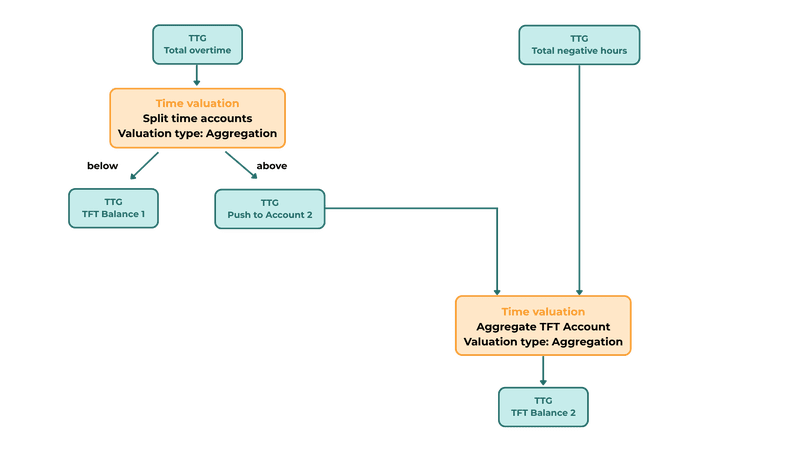
Valuation 1: Split Time Accounts (Type: Aggregation)
Input: The TTG Total Overtime feeds into this Time Valuation.
Output below: As long as Account 1 is still negative, hours flow via the below path into the TTG TFT Balance 1, which corresponds to Account 1.
Output above: Once Account 1 is balanced, the above path routes hours into the TTG Push to Account 2.
Valuation 2: Aggregate TFT Account (Type: Aggregation)
Inputs: This Time Valuation receives two inputs: the TTG Push to Account 2, and the TTG Total Negative Hours, which collects absences and negative hours.
Output: The result is written into the TTG TFT Balance 2, which corresponds to Account 2.
The Integration
Since Time Container values do not automatically populate Time Accounts, two integrations are required.
The first integration creates the Time Accounts for an employee as soon as the corresponding Time Containers exist in the system. This ensures that Account 1 and Account 2 are available from the moment the configuration becomes active for a given employee.
The second integration runs on a regular schedule and writes the current container balances into the respective Time Accounts. This keeps the displayed balances up to date without manual intervention.
Why This Matters
This example illustrates a recurring challenge in SAP SuccessFactors Time Tracking implementations: the gap between business logic and technical configuration. A requirement that sounds straightforward: two overtime accounts where one fills before the other. It requires a precise combination of Time Valuations, Time Type Groups, Time Containers, and dedicated integrations to implement correctly.
Getting the configuration wrong at any point in this chain can lead to incorrect balances, incorrect payroll output, or accounts that do not behave as expected. The integration layer is particularly critical: without it, the calculated values remain invisible to employees and managers.
At Clarity Solutions, we help organizations design and implement complex Time Tracking configurations in SAP SuccessFactors, from standard use cases to custom requirements like the one described above.


